Why is it so hard to predict the future? by Sam Hawksmoor

Realm-Of-Fantasy-World-Digital-Art
I grew up on Philip K Dick and his fantasies about global nuclear war, robots that were indistinguishable from people and a world engulfed by consumerism. Luckily global nuclear war didn’t arrive yet, but who is to say Iran or North Korea won’t oblige in the future? Oddly enough Dick’s vision of our society isn’t far off being right. He was a paranoid delusional but that doesn’t mean his vision of a planet where everything is under surveillance won’t come true.  But it may not end up with totalitarian states. North Korea notwithstanding, or President Putin or Chinese Leader Xi Jinping trying to put the concept of free speech back in the bottle.

Dictators understand that they cannot allow the internet into their society.  Free Information has the potential to undermine communist control in China and as much as they try to contain it, smart people work around it. (And face the consequences if found out).

The law of unintended consequences rules however.  Twitter and NATO helped topple Gadaffi in Libya but now we have civil war in Libya, as no one prepared for the end game. Worse ISIS has taken control of a large chunk of the country and shipping migrants and terrorists into Europe as fast as they can. As Assad and Putin destroy pretty much all of Syria – driving everyone who doesn’t want to live under Assad’s dictatorship out. We reap the harvest of Syrian migrants because we lack the courage to make united efforts to tackle oppression. The ruined city of Homs or Aleppo stand as a monument to extreme cruelty and a warning to our own cities in Europe that face an enemy that cares nothing for human lives.

Despite the misery in our headlines we love reading about or watching disasters. The destruction of an ecologically perfect planet by rapacious soldiers led by a fascist moron became one of the most successful movies of all time. Avatar To be honest I could have enjoyed it just as much without the soldiers (or the proposed three sequels.)
We live endlessly with this idea of paradise lost and it crops up again and again in fiction.  Yet paradise is and has always been an illusion, or at least something that only very few people ever experience, usually at the expense of the toiling masses. The elegant classical rich merchant mansions that followed land enclosure demonstrates that well enough. The idea of entitlement first came to those who gave themselves ‘titles’. Downton Abbey was built on greed.

Social Media is Freedom or Oppression?

Funny-Selfies-37-570x745Speaking for my generation, I prefer privacy. I realise, sometimes with shock that the young don’t care for it all. They want to share everything about their lives, every scrap, bad and good, nothing is private, their joy or bitterness and this is the enemy of totalitarian societies where secrets are power.  Facebook rules the world alongside Google.  People not only know where you live but what you eat and whom you sleep with and it doesn’t seem to matter.  No one predicted this. Not even William Gibson. No one expects the unexpected I guess. The Selfie Culture rules. However scrubbing that past away when you no longer need it or want to hide it is a diferent matter. Your future employer will be watching too and judging. **Possible career option of the future Social Media Scrubbers…. We Clean Your Past.

Take an alternative view of society portrayed by movies and books such as:
A Clockwork Orange, Escape From New York, Total Recall, Outland, Snow Crash, Land of the Dead, Sin City, The 100… The Wasteland (short stories)

The futures they show are hell on earth. Everyone is a criminal. Extortion and prostitution is the norm, as is disease and a short life expectancy. Sometimes they are prescient however. We are moving to a world where anti-biotics no longer work. We live in a world were population growth is out of control and political corruption rules. (See Africa).

Mexico is a virtual drug economy where gangsters regularly do mass killings and mass corruption of the police and army is normal. You can say the same in Nigeria, Zimbabwe, Sudan. Most sci-fi stories set a human and ecological crash in New York or LA or Chicago, but it’s much more likely to be Lagos or Jo’Burg. Where is that great Mexican novel that is tune with the reality of a failed state underpinned by oil and drug money that flows only to a few corrupt rich?
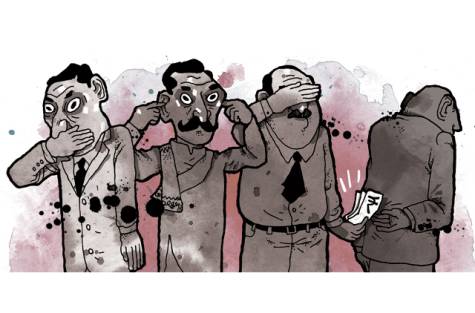
CorruptionNew2-275mgg0
You can point to Detroit as the city that time forgot and yes you can easily build a case for dystopia there, but then again, some people are beginning to reclaim the empty city lots for urban farming and who knows, people might start to rescue the abandoned art deco factories and homes.  A new non-industrial eco-city might blossom.

It is easy to come to a judgment about the death of capitalism by looking at Detroit, but if you know your facts you’ll always know that the history of America is to ‘use’ then ‘discard’ and move on.  Gentrification and preservation are relatively new ideas there. In the seventies people were writing off New York, garbage was piled high on the streets, crime was rising exponentially and real estate crashing.  It was rescued by human will and the enforcement of laws.  Fixing ‘broken windows’ mantra.

cyberpunk_city_street_by_klauspillon-d83vj59

It’s too easy to write whole countries off, but if you take the long view you can be a much better predictor of events.  Cities will continue to grow and thrive because that’s where the jobs are.  Cities of fifty million people won’t be unusual in the next fifty years.  Whether you’d want to be living there is another matter.  The future LA of Bladerunner was based on a reaction to a visit to Hong Kong by Ridley Scott.  Predicting is fraught with danger.  If you had told anyone in majority-white Vancouver forty years ago that 45% of the population would be Asian in 2016 they would have considered you mad. Not only has the population changed, but what it does and how it lives and eats and of course came with it the rise of gang culture, crime and a much more dynamic city.  Speak to a futurologist and they will tell you the future is China and they will come to dominate the world.  But this may not be inevitable.  Internal dissent is rising – a desperate Government has to keep growth at 7% to keep a lid on it and it is struggling to do that. The country is exposed to outside influences that often contradict what the Government wants and believes. Air quality is a political issue. Schools built on contaminated ground ‘normal’ as there are no checks and balances on corrupt officials.

Around 1600AD China had seen the world and suddenly closed the door on it.  Who is to say they won’t do that again? Of course since they are the world Number Two economy it would cause an economic catastrophe if they suddenly stopped buying our ‘stuff’, but I’m not predicting they will. The Chinese are rich now with 193 billionaires according to the Sunday Times Rich List April 2016. It would take some extraordinary malign political power or catastrophe to halt or reverse Chinese consumerism.

Europe is flattening economically. We are probably a bit disappointed that Greece elected to stay in the Euro. We were all secretly ready to watch the road crash of the Euro collapsing like your auntie who always said about your boyfriend or girlfriend that it would all come to a bitter end.  It hasn’t yet and beware of predicting that it will. The closer one is to history and events the harder it is to see ahead I guess. Now Britain flirts with the idea of ‘Brexit’, leaving the European Union. It’s a crazy idea actually, to walk away from a market of 500 people and probably an illusion we would be any freer outside it. Poorer certainly and it would be irreversible, we couldn’t change our mind a year later and ask for our coat back. It’s divorce and everyone knows that both parties get hurt in a divorce. Only the lawyers go home happy.
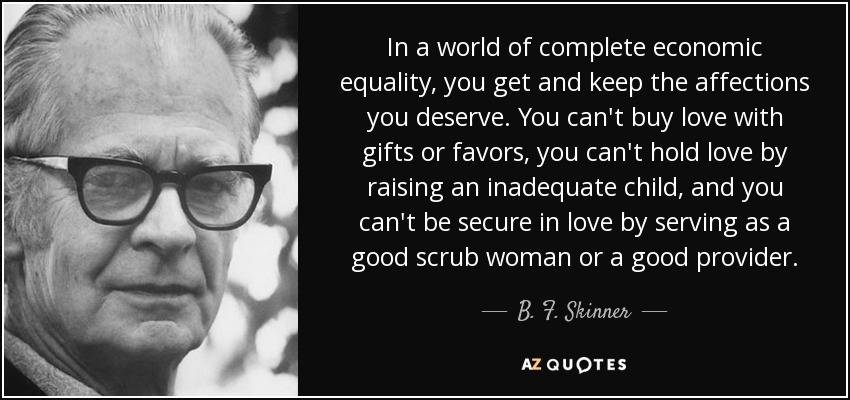
quote-in-a-world-of-complete-economic-equality-you-get-and-keep-the-affections-you-deserve-b-f-skinner-120-4-0482

Right now everyone says it’s like the 1930’s and therefore history will replay as fascism or communism, but history usually repeats only as farce. Averting our eyes to poverty is very human.  Ever seen the pictures of people sunbathing on Spanish beaches as illegal African immigrants wash ashore and scavenge in the bins. It really happens. Right now the same is happening in Greece and Italy as boats still come every day laden with migrants and aim to make their way to Germany. But how many of these migrants end up in work? And if they don’t get work or money what will they do? Europe has compassion fatigue and no one is happy about the deal with Turkey. So many people in Turkey want to leave and seek freedom of expression from an increasingly oppressive government. They will hardly want to return once their visa’s expire.
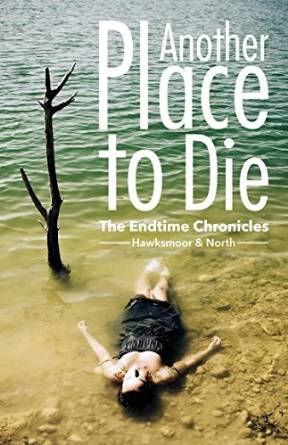
download (3)Twelve Monkeys – the movie, (now a TV series) is a favourite movie of mine.  Having written a pandemic novel myself (Another Place to Die : Endtime Chronicles) I look at this with awe.  Yet people surviving underground for decades?  This requires some organization.  That this disjointed group would also discover time travel is cool but highly unlikely. But I’m not judging. We’d all like to believe it will be possible. Time travel will probably be always a delusion.  (I’ll look at the back door now in case my other self cares to step in and correct me – no? Well I’m disappointed.)

This doesn’t stop us writing about time travel as a literary device.  It’s so tempting to go back and ‘fix’ stuff or mess with it. Talking of which ‘Abraham Lincoln – Vampire Hunter’  Are they serious?  Teaching history is going to get real complicated I think from now on.  No, Miss Elizabeth Bennett was not really a zombie, nor Mr Darcy, but your kids might think they were.
abef87bb54b59184946691d9688a54e7
The science fiction I enjoy is about us, about our society and the things that are transforming us.  Can we get things right?  Neal Stephenson perhaps got closest to predicting the death of the high street and how the mafia will come to control the economy.  Even now I find it hard to believe that people won’t want to wander a mall in future or Winchester High Street and have coffee and see a movie, ‘cause what else will people do with their time when it all disappears?  Shopping on-line is well – boring. Maybe they’ll be shopping in 3-D. Thrilling huh. Department stores are so last century but I wonder what people will do with their time if they don’t ‘shop’. Attitudes change, lifestyles have been transformed by smart phones. Read a whole book? Are you kidding? Kids with neck problems from staring at phones all the time and arthritic thumbs from texting are temporary phenomena. Having a personal drone recording every moment of your life 24 hours a day – the norm! It’s coming. What will you do if your drone leaves you to follow someone else because their lives are more interesting? Only kidding, don’t fret.

la-na-tt-trump-fascist-inclinations-20151209-001 (3)

Predicting the future at this moment is much harder than usual. President Trump or President Cruz? Both would be a disaster, Cruz more than most and expect all the rights women gained in the last decades to be reversed by him. Who knows what kind of world it will be in 2020 after he’s turned the clock back and dismantled Obamba care.
Paulo Bacigalupi is the most prescient writer I think with his Ship Breakers and The Wind Up Girl, both required reading for any sci-fi readers. Here is a guy who has really thought about the future.  But in Ship Breakers all he had to do was observe that on the India coast labour is so cheap that they break up decommission ships by hand. Transpose this to the USA and you have a future shock. His latest The Water Knife is about who controls water rights in a Climate Changed USA – It couldn’t be more relevant. Read it now if you haven’t.

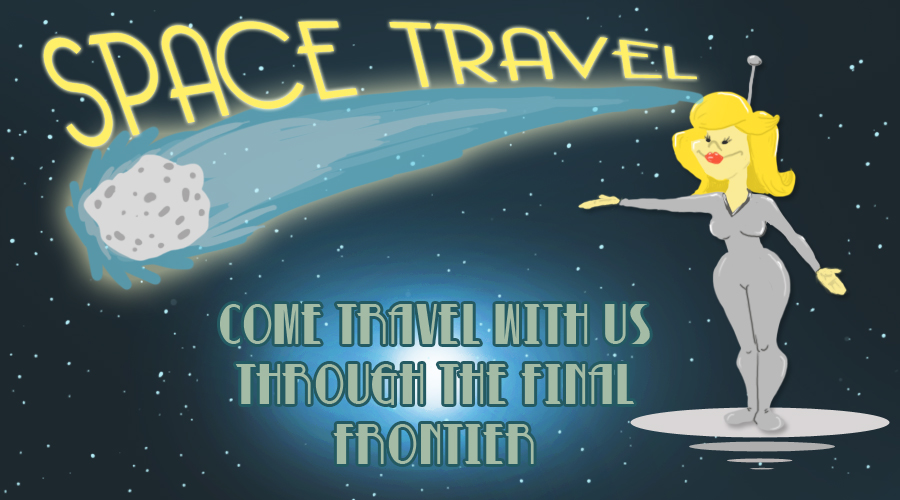
The same goes with space travel.  Studies show us that the longer humans are in space the greater the risk to bone density.  Essentially if you intend to go to infinity and beyond you aren’t coming home again.  Not many sci-fi writers seem to get that. Given what is happening right now on Earth that might be tempting to go into space but psychologically will we ever find the right kind of people to make the Star Fleet if they know it is a one-way ticket?  And where is that Warp Drive?  Has Dyson got the patent yet?  We got to the Moon forty years ago but here we are still stuck in the fossil fuel age and planning nostalgia trips to the lunar surface at £100 million a ticket.
105568_mrcreeep_space-travel-ad-1

This brings me to teleportation. Another popular theme in fiction. My novel The Repossession (TOZ in Turkey) is in part a study of that phenomenon. What follows is a discussion about just how hard teleportation will be to develop:

**This is an © extract from a scene at the dinner table in Chapter Two between Rian and his tormentor, his Mother’s boyfriend.

Teleportation is bunk, Rian.  Pure bunk.  No one will ever beam up Scotty.  It’s impossible.  The future never happened.  There are no aliens and we don’t commute in flying cars.  Star Trek is rubbish science.  Bunk.”
The usual dinner conversation.  Rian would say something and Mr Yates MBA would pounce on it, try to make himself look clever, and his mother would eat it up.  Nevertheless, Rian defended his position.
“I’m just saying that if we accept climate change as inevitable then teleportation would eliminate air travel and that’s a whole lot of pollution that goes with it.  We could save the polar icecaps and the bears.”
Mr Yates stared at Rian a moment and Rian could see the muscles in his thick red neck pulsating as he sought to deliver a withering reply.
“You shouldn’t bait Mr Yates, Rian,” his mother said.  “You know science-fiction is just that, fiction.”
“The problem with science-fiction,” Mr Yates finally barked, “is that it makes people believe that there are solutions for everything.  There aren’t.  Take teleportation.  What you envisage is just magic.  It can’t happen.  The amount of energy needed to deconstruct a human made up of trillions upon trillions of atoms would be equivalent to the energy output of ten nuclear reactors, at least.  Plus, reassembling those same atoms back in the right order is a monumental logistical task.  Way beyond what any software programme could do.  We are talking turning your whole body into digital form, into photons, and sending them across town by light waves, then putting it back together exactly as it is now.  Your clothes too.  Impossible.  One slight wrong calculation or dropped piece of code and your arm will come out your head or you’ll just collapse into a heap of jelly.  It would have to reassemble skin, bone, and eyes.

Heavinessth1            “It would need the basic carbon raw materials to generate it at the end destination.  Any idea how complex your eyes are?  Hell, just putting your feet back together would be beyond the power of any machine for decades ahead.  Decades.”
“Scientists say…” Rian began again, but Mr Yates interrupted.
“Quantum physics states that you cannot say for definite the position and velocity of any single particle.  More importantly, Rian, for teleportation to work, and let’s assume someone actually has all the computer power in the whole world at their fingertips to store a trillion, trillion atoms – in order for you to be ‘transmitted’, much like an email with an attachment say, you, in the process of being disassembled would be destroyed.  The new you across town would be a copy and each time you moved you would be another copy.  Can a computer also deconstruct and store your memory?  Your imagination?  If it can’t, you would be a 16-year-old baby with no memory of anything.  Your memory would get wiped every time you teleported.”
“Never mind losing your soul, Rian,” Mrs Tulane interjected.
Mr Yates beamed at her.  “Quite.  Every human is unique – I’m telling you it will always be totally impossible.  We should not play God.”

© Sam North/ Hawksmoor May 2016

Discover Original New Fiction
www.samhawksmoor.com
Read The Heaviness of Genie Magee – the secrets of anti-gravity revealed.
‘The Best Genie Magee story left till last.’

Although Sam writes about the troubles of the world in his books he always writes to the overcoming of them, we are facing troubled times, we have made a mess of things, but as we made the mess, it is time for us to clean it up, so get of we are doomed wagon and step to making the changes, it all starts with each one of us, in the way we vote (Bernie) the way we treat each other, the respect we have for self. The only reason tyrants and dictators have power is because you handed it to them, underneath all that power-hungry ego are scared, little boys.

This is an awesome world, let us stop f—ing it up and do something about it.

Sara Troy. 

More stories like this here hackwriters.com

www.samhawksmoor.com

The Psychology of the Fear of Flying and How to Overcome It • Phoebe Parlade

••• The International Writers Magazine: Fear of Flying

download (2)


Do you have a fear of flying? If so, you are not alone. Many people are afraid of flying and go to extreme lengths to avoid it. Some people get so anxious on flights that they turn to alcohol and prescription medications to cope, only to later end up with bigger troubles after becoming so intoxicated that they try to brawl with others on the plane.

If you are afraid of flying, avoiding taking a flight is the worst thing that you can do. Learn why that is true and identify ways to confront the underlying cause of your anxiety. This fear of flying article explores factors that trigger fear of flying. It also provides helpful advice about strategies that you can utilize in the short-term to overcome your fear. Long-term solutions for coping are also reviewed. Get started on overcoming your fear of flying now.

The Psychology of the Fear of Flying and How to Overcome It


It’s October 15th and Alija Kucuk is preparing for his flight from JFK airport to Palm Beach International  in Florida. Kucuk has an intense fear of flying and to try and calm his nerves, he takes some Xanax and then starts drinking. By the time he’s on the flight, he’s a mess, and the subject of one of the more infamous air rage incidents in recent times. His intense fear of flying led to an extreme attempt to knock himself out, which failed, turning into an on air brawl.

Kucuk is not the only person to have turned a fear of flying into air rage while in a plane. Many more avoid flying wherever possible, travelling by car or train to far off places in order to avoid going up in the air. Some famous cases include Whoopi Goldberg who drives from state to state, and Sean Bean, who climbed New Zealand mountains to avoid helicopter rides while filming his part as Boromir in Lord of the Rings. What causes this fear of flying and can it be overcome? This guide attempts to answer both of these questions.

Part 1: A Fear Of Flying

What are the root causes of the fear of flying that presents itself in some people but not others. In this section we consider whether it is a phobia or a rational fear. Then we take a look at a number of triggers and how the psychology of a fear of flying works.

Fright Or Phobia?

Is a fear of flying a rational fear or an irrational one? A fear of guns, for example, is wholly rational as is a fear of alligators or tigers. An irrational fear or phobia is a fear of something that is not in itself dangerous such as a fear of spiders (arachnophobia).

In terms of terminology, this paper refers to the condition as a ‘fear of flying’ because no better term has been invented. The Diagnostic and Statistical Manual of Mental Disorders defines a specific phobia as “an anxiety disorder classification that represents unreasonable or irrational fear related to a specific object or situation.”

For this reason, we will not be referring to it as either ‘aerophobia’ or ‘aviophobia,’ which are better transcribed as fearing drafts of air. For the sake of clarity and consistency, we will also refrain from using other common terms including flying phobia and flight phobia.

Fear of Flying Triggers

Our fear of flying can be caused by a wide variety of reasons. These include by rational and irrational concerns. Rational causes can be best defined by the reaction to the 9/11 attacks. After these terrible events, less people bought air tickets and instead chose to drive or use public transport to cover long distances. Similar things have happened after crashes or if certain airlines have a bad safety record. These are rational responses which tend to die down after a period of time or if a company is proven to improve itself.

Such incidences also act as confirmation events for people who fear flying. Constantly reading about the relatively few crashes and disasters reaffirm concerns, but they can also trigger new cases. As Alex Preston has written, “flying is a magnet for our vulnerability, for our fear of death, for our existential panic” and every incidence of failure reminds us how unnatural flying is to human beings.

Others, such as Captain Tom Bunn who has spent three decades developing effective methods for treating fear of flying, believe different triggers may be at play. These can relate to childhood traumas or PTSD – Post-Traumatic Stress Disorder. “When an upcoming flight comes to mind, we are bothered by the same things that bothered us in childhood: being alone, powerless, not responded to, and unable to escape.”

In addition, there are strains of thought suggesting other phobias can come into play which cause a fear of flying. Taken at face value, this means any reaction to flying or the thought of flying is a symptom of a wider psychological condition under the DSM’s specific phobia definition. Phobias such as claustrophobia, acrophobia, and agoraphobia have been cited as potential triggers for panic attacks before or during flying.

Existing phobias build into a wider range of anxieties and concerns which may put people off or place them in a difficult psychological position. These include social anxieties caused by crowded conditions and being surrounded by strangers. They also include triggers such as hot, stale air, not being in control of the situation, not knowing the cause of bumps, strange sounds, actions and turbulence, or a lack of trust in unknown air staff and pilots.

The Triumph of Imagination

fly

Captain Tom Bunn highlights the lack of reason or logic in the fear of flying. Afterall, only one in 45,000,000 flights lead to a fatality. If we go back to Alex Preston’s piece highlighting all the incidences he’d read about, you would not think so. Bunn terms it as a triumph of the imagination over reason, showing the ultimate cause is within our own minds.

The man can over dwell on a certain thought or fear. If blended in with a phobia such as claustrophobia, control conditions such as OCD, past traumatic events leading to PTSD, or social anxieties the mind can take those issues and project them onto the idea of flying. It then is unable to escape a spiral of thought, fear, and reaffirmation leading to stress, anxiety, and agitation. Some, like Kucuk try to take medications or drink to solve the problem, but this can often make it worse, leading to a high profile blow out. In most cases, sufferers become so averse to flying they either restrict their own travel or take long overland or sea routes instead.
Information Sources

References:

Bunn, Tom, 2015, Fear of Flying: Suffering From Imagination, Psychology Today
Bunn, Tom, 2015, Why It’s So Hard for Anyone to Get Over Fear of Flying, Psychology Today
LeBeau, Richard T., Glenn, Daniel, et al, 2010, Specific Phobia: A Review of DSM-IV Specific Phobia and Preliminary Recommendations for DSM-V, American Psychiatric Association.
McMahon, Paula, 2016, Jail for Man who Attacked Flight Attendant, Threatened to Blow Up Flight to S.Florida, Sun Sentinel, FL
Mouawad, Jad, and Drew, Christopher, 2013, Airline Industry at Its Safest Since the Dawn of the Jet Age, New York Times
Oakes, Margaret & Bor, Robert, 2010, The Psychology of Fear of Flying (Part 1): A Critical Evaluation of Current Perspectives on the Nature, Prevalence and Etiology of Fear of Flying, Travel Medicine and Infectious Disease, Vol.8, Issue 6.
Richmond, Raymond L., 2013, Fear of Flying, A Guide to Psychology and Its Practice, website

Part 2: Overcoming the Fear of Flying

It is possible to overcome the fear of flying, but it means confronting the underlying cause whether that is through better education over flying safety, understanding your triggers, or your other phobias. This section will cover a few ideas on how to overcome your fears.

Personal Psychology

miamiflyingFor most people with a fear of flying, as we have seen, the cause is linked to the self and the triumph of imagination over reality. This also means that the solution to the problem lies within ourselves and how we both view and approach the world.

The aim is to reduce the release of stress hormones in this situation. When stressed, we produce oxytocin to inhibit the amygdala. If you can reduce your oxytocin production in an airport and when boarding a flight, you will have no problem. There are generally speaking three steps to controlling anxiety:

– Identify flying as being non-threatening.
– If there is a threat, take control of the situation – concentrate thought on what you would do if a situation occurred.
– If control is impossible, escape.
The Anxiety and Depression Association of America go further by outlining a wide range of coping strategies. Many of these apply to the fear of flying and can be divided into those which help you at that moment of anxiety, and those which help you in the long term when not immediately faced with flight. They are backed up by Professor Robert Bor, as specialist in the field and author of several books on the subject.

In terms of the moment:

Think about the destination, not the journey
Take a time out to meditate
Challenge negative thoughts
Stay hydrated
Limit alcohol and caffeine
Accept that you cannot control everything
Welcome humour into the situation
Maintain a positive attitude
Talk to the cabin crew
Plan ahead
Consider the long term solutions too, by practising these, the short term tips for overcoming anxiety will become easier:

Learn about what is triggering your anxiety
Study positive information about flying and the fear of flying
Get involved with other sufferers or aviation groups
Eat well-balanced meals, exercise regularly, and get plenty of sleep
Study yoga and relaxation techniques
Talk to someone about the problem
Get educated on flying
Taking the initiative yourself is not for everyone. Do not be afraid to see a psychologist or counsellor so you can find a path for overcoming your fear or deeper anxieties/phobias. This is especially true for PTSD sufferers.

Take a Course

Believe it or not, but many airports and airlines run courses and workshops for people with a fear of flying. Alex Preston found himself on such a course run by Virgin Atlantic. Founded and run by cabin crew and Virgin staff, the course runs a number of seminars aimed at helping people bet flying-related trauma.

These courses, also found in America and Europe, cover the physics of flying, tackle common misconceptions head on, and explain events such as turbulence. They also include relaxation techniques and plenty of reassurance. If you can afford such a course, it is well worth making one part of your education and anxiety focused treatment.

Helping Children Overcome Their Fear

Children can be just as scared of flying as us wary adults. In fact, they can be more scared or suffer from the traumas which develop into a phobia in later life. When examining a child’s fear it is important, according to Roy Benaroch MD, to consider if the fear is part of a larger issue to do with anxiety or a part of other phobias. Or perhaps, it is born out of a lack of understanding of air travel coupled with scare stories.

Flyfright.com and Benaroch agree that the most important thing to do is to talk to your child and to slowly introduce them to the thought of flying. Start a few weeks before a trip, ask how they feel about flying and if they are scared about any aspect of it. Talk them through how planes work and the process of boarding, flying, and landing. Explain what turbulence is, fog and other things which might affect the flight.

Also consider:

Encouraging your child to talk rather than to cry or throw a tantrum
Let your child watch real planes
Let them bring a comfort item
Bring books, toys and other distractions
Give them toy airplanes
There are also courses available. Companies such as Virgin Atlantic and British Airways offer child friendly courses. The BA course is divided between kids aged 7 to 11, and those aged 11 to 17. All courses are hosted by professional staff and professional counselling teams. If your child is not responding well to education and quiet comfort, consider using a child psychologist to further work through the issues.

You Can Do It Too

Remember Sean Bean? He spent hours climbing mountains to film short scenes as Boromir, the tragic villain-cum-hero of The Fellowship of the Ring. Throughout his life he’d avoided flying wherever possible and especially disliked flying in helicopters.

Filming in New Zealand helped him overcome some elements of his fear by simply giving him no other choice if he was going to fulfill his role. However, the filming of Flightplan (2005), a movie co-starred with Jodie Foster, he put serious effort into overcoming his fear. This involved going to flying school and learning about how planes work. Knowing how resilient they are and racking up the hours have, while not making it much more pleasant for him, have dulled his fear and allowed him to fly more often,

If Sean Bean can do it, then so can you. Take your time, reach out for more information, learn how flying works, take courses, speak to professionals and find ways to calm your mind. Most of all, take the big step of trying it. It will not be easy at first, but as Sean Bean shows, with time, it can become easier.
Information Sources

References:

ADAA.org, unknown, Tips to Manage Anxiety and Stress, Anxiety and Depression Association of America
Benaroch, Roy, 2012, Fear of Flying, The Pediatric Insider, website
Bor, Robert., Eriksen, Carina., & Oakes, Margaret, 2009, Overcome Your Fear of Flying, Sheldon Press
British Airways, unknown, Children’s Courses – Flying with Confidence, website
Davis, Darrell, unknown, Fear of Flying Tips for Children, Flyfright.com
Jones, Charisse, 2014, Airports Take on Fear of Flying, USA Today
Unknown, 2005, Q&A with Sean Bean, Phase 9 Entertainment
Virgin Atlantic, unknown, Flying Without Fear, website
Walker, Tim, 2009, Why Fear of Flying is Just Plane Stupid, The Independent, London

halloween © Phoebe Parlade April 2016

More stories like this here hackwriters.com

My Prince is gone by James Campion

Hackwriters.com ••• The International Writers Magazine: Reality Check

Prince Rogers Nelson – 1958 -2016
• James Campion

Prince

I do not want to write this shit.
Not now. Not ever.
This is personal.
But it’s either this or continue sitting around enduring this sick feeling of inertia on the edge of a loathsome face-off with mortality.
So…whew…here goes…

During the most prolific musical period of my life, my early twenties, when I wrote and played music for a living, more or less, there was only one artist that mattered; Prince Rogers Nelson.

Prince2.jpg

This was a dark time of transition for me from the late ‘70s Punk movement into New Wave and then a lot of stuff I did not relate to on any level beyond a strange imbalance of apathy and abhorrence. There was U2, the Violent Femmes, a little later, Jane’s Addiction, REM, the Beastie Boys and Public Enemy, but mostly, I was lost. But one thing that could always be counted on was a new Prince album that would snap me back into coherence and make me love new music again, as I did when I was a kid and wore out all my 1960s to early 1970s stuff.

From 1980 to about 1998, Prince was a mother——–. He wrote, produced and played on more songs than any living human. Period. In a time when major artists put out an album every three to four years, Prince dropped one, and in some cases, two annually. He once released The Black Album, pulled it, and replaced with another one (Lovesexy) in two months, then leaked the former on bootleg. He bootlegged himself! The 1996 album, Emancipation had thirty-six (36!!) really good, really interesting songs on it. In ’98, Crystal Ball had fifty-one incredibly disparate and engaging tracks. On the bulk of these seemingly endless and brilliantly devised discs, the majority of which were huge hits with even bigger hit singles on them, he played every instrument, frighteningly well, and sang all of the parts; some five-part harmonies worthy of the Temptations meets Brian Wilson on a funk jag.

Prince

Prince lived in the studio. Literally. He built the damn thing where he lived. Turns out, he died in it. He did not drink. He did not use drugs. He did not attend gala industry parties. He rarely did any interviews or appearances. Hell, he barely ate or slept. He wrote, played and recorded music. When he left the studio to tour the world, he would jam with locals and members of his band in clubs in every city. He played the bass, drums, guitar, piano, and sang back-up and lead, or whatever was needed. He played every kind of music expertly. He listened to and absorbed every kind of music copiously. He was a sponge and he was a spigot that poured forth inspiration.
Those who sessioned for him swore he would force the best from musicians, because he was better than any of them. For a mind-numbing spurt in the mid-to-late 80s, Prince wrote, performed, and produced major hits for many artists; The Time, Sheena Easton, Chaka Kahn, TLC, The Bangles, Sheila E., Stevie Nicks, to name a very few. He started “mask” bands like The Time, The Family, Mazarati, Vanity 6, so he could put out four or five albums a year. Two years running he put out jazz albums under the name Madhouse and created characters to sing and produce other works, Camille and Jamie Starr to name just two. Later he changed his name to an unpronounceable symbol just so he could record anywhere and everywhere to escape the confines of a music business that could not handle him.

Every single he released during this time came with an adjoining twelve-inch extended version with completely fresh B-sides that were often superior to some of the tracks on the albums. Time and space precludes me from making a very strong argument that “Erotic City” is the best side of anything anyone put out in the 1980s, and it was the B-Side to “Let’s Go Crazy”, which is the fifth best song on his monster album/film, Purple Rain. And Purple Rain, which won Prince an Oscar, Grammy’s, et al, and has sold a stunning 22-million copies worldwide to date, is not nearly as good as 1987’s Sign ‘O’ The Times, which I still believe is by far the finest, most diverse and experimental pop record of the decade.

Here’s one for you; I maintain that the best song Prince ever wrote is one he never even recorded as Prince or the symbol-thing, “Nothing Compares 2 U”, which Sinead O’Connor’s gorgeously heartrending version turned into a smash hit. I first heard it performed by one of his aforementioned “mask” bands, The Family on its only album in 1985; no doubt with a backing-track played entirely by the composer. If there is a more painfully framed slice of love-loss than “All the flowers that you planted, mama, in the backyard…all died when you went away”, I’m waiting to hear it. The thing floors me every time. Every time.

Prince songs are genre-less. It was Prince – everyone else. There was rock, funk, punk, pop, jazz, fusion, reggae, ska, rap, classical and a collection of aural oddities that brought a dynamic charge to each successive listen; songs about sex and love and race and sex and God and loss and sex and power and dreams and sex and pain and joy and…yeah, sex. Sex was Prince’s gateway to the spiritual (orgasm as transmogrification), the political (seduction as liberation), the revolutionary (transgender identification), with all those substitute word/symbols thrown in to give it all a literary spark. Listening to Prince back then was a lesson; sit up, take notice, learn the craft, be the music, dig the vibe. It was the experience you looked forward to, because you would not be disappointed.

Maybe it’s because he controlled everything; his image, his fashion, and of course his music. It led to the outstanding and the outlandish. No one was there to say no to Prince, from the first album when he was barely 20 years-old and somehow convinced Warner Bros to allow him to produce his own records. There was no Quincy Jones or George Martin for Prince Rogers Nelson. He was the one who decided to pull the bass out of “When Doves Cry” or create an entire alternative-concept album around a Batman movie or direct a black-and-white French film that bombed so badly it is hard to believe he wasn’t ruined (for the record I like Under a Cherry Moon better than Purple Rain, so there), and certainly no one counseled him to demand everyone stop calling him Prince and release instrumental jazz-rock fusion records after multi-artist compilations and then shun the entire record industry altogether. Nope. It was all Prince, for good or ill. That kind of freedom is power and it led him, and us, to some pretty cool places.

My favorite Prince musical memories, beyond the dozen or so times I saw him play live with some of the best musicians I have ever heard/seen anywhere, is all that wonderful first-time stuff. You know, first time I heard “Purple Rain” at three in the morning driving home from some gig; letting the opening chords and the first verse sink in, then turn it up a little for the second, and by the third, where he shreds his vocal chords and the goddamn fret board, let it blast away. The first time I cracked open the shipping box for Around The World In A Day, still sort of my favorite Prince album, two days before it was to be put on the shelf (I was working at Record World in Westchester at the time), and running home to play it; the weird Indian raga and the screeching wail of a guitar into vocal, then all that stuff afterwards that runs into “Raspberry Beret” and “Pop Life”, and that weird shit at the end where he is fucking and talking to God or whatever the hell is going on there. Hearing “Kiss’ for the first time; the bare, stark, air-sucking naked compression of everything that thump-kicks you in the face and the gut and the balls; ushering in that pinch-chirping falsetto; “You don’t hafta be beautiful…” My first listen to Sign ‘O’ The Times; his masterpiece; his Exile on Main St., his White Album, his Blonde on Blonde – Fuck it; go listen to Sign … right now…do it!

I remember the friends and lovers too. We were the special ones, the ones who dug Prince before he was the shit and after he stopped being the shit when the shit came down on him. You know who you are, but I have a special place in my soul for my dear friend and drummer, Anthony Misuraca. Shit, Anthony and I would listen to Prince everywhere; the car, the house, the studio, the roof, the basement, the street; morning, noon, night. We’d pick out chords and riffs and lilts in his voice; You hear that? No? Listen to this…man! We drove from Raleigh, North Carolina to Madison Square Garden on August 2, 1986 to see The Revolution ply its trade. I remember it because it’s my brother’s birthday, and because we did it. It was my first Prince gig. I chased down Prince concerts after that; every single one better than the next – although for my money the Lovesexy Tour 1988 beats all-hell; in the round, a tour de force. I caught it three times.

That was the thing about Prince; it was personal for those of us who dug him. We got our copy of Uptown magazine every month at Revolver Records on West 8th Street and argued about the alternative mixes and studio outtake/live bootlegs and after-hour show tapes and how each song referenced the other song and it coalesced into this other thing entirely. It was a 70s kid thing for a lot of us, who grew up, like Prince, on imagination, amalgamation, and organic clout in our music. We understood when Prince released a B-Side at 45 rpm, but if you slowed it down to 33 rpm it is a tribute to the third track on the fourth Sly and the Family Stone album. We knew when he referenced James Brown in “Get Off”; “Some like ‘em fat…” or rolled into Joni Mitchell’s “Help Me” in the bridge of “The Ballad of Dorothy Parker” or that odd Stones riff he hides in “Ronnie Talk To Russia” or the Hendrix feed-drenched guitar-screams in “All The Critics Love You In New York” or the Black Sabbath-esque foreboding intro to “1999”, or the blatantly obvious Marvin Gaye homage suite in “Do Me Baby”. We got it, man. We loved it. He understood what made us tick. He gave us a soundtrack to our soundtrack.

For the longest time, there was a Prince album and Woody Allen film every year. Like clockwork. And they were always challenging and engaging and inspiring. This was what I counted on. Like Christmas or birthdays for others. The other day I thought about a time when the 80 year-old Allen would no longer be able to tell his celluloid stories. This I get. It’s going to suck, but I get that. But Prince? He is 57. I am 53. We hail from the same post-Boomer/pre-X generation that produced a shitload of really cynical, wise-ass jerk-offs, who cannot believe there are still illogical, racist, sexually-repressed assholes running around using the same tired bullshit to tell us what we can listen to or eat or fuck or wear; that we thought we had somehow changed things by merely living on and making it to the future; it is what Prince meant when he wrote in the liner notes of every record, “May U Live To See The Dawn”.

Suddenly you wake up and the future is the past and your present is the dumb shit your parents and their parents had to deal with. You sleepwalked through all this proposed revolution. You expected something new and vibrant, because you imagined it. Maybe it was all just marketing. But you come to accept it. It’s fine. It’s life. And then with no warning and no reason Prince up and dies and dredges it all up. A wild, eccentric crazy man, whose art was life, is gone – who wore nothing but garters, silk-stockings and panties on stage and ass-less pants on Arsenio Hall and stuck the Lord’s Prayer in the middle of a funk song about interracial homosexuality and turned songs about Armageddon into a party-pop hit you could roll out on MTV with his interracial, cross-gender rock/funk/pop band, conflating images of Jesus, smack, slavery and cunninlingus into a song about flowers.


I was reminded today of that little nugget from Toure’s 2013 treatise on Prince, I Would Die For You – Why Prince Became An Icon, which I reviewed and truth be told, inspired my own foray into such an investigation on KISS in my last book, Shout It Out Loud – The Story of KISS’s Destroyer and the Making of an American Icon. “Toure writes of “emerging adulthood” this way: “Sociologists say people fifteen to twenty-five are in active identity formulation mode, as opposed to thirty-somethings…part of why we like certain artists is that we like the other people who like them, we enjoy being associated with or attached to those people, we want to be in a tribe with them. After thirty that social transaction is less valuable.”

Today, as I write this, those words ring true. I already knew all this, it’s obvious, but when that touchstone, the focal point of a tribe long gone dies, it can unsettle the odd illusion. I have to admit, it triggered something deeper in me than mere fandom. My friend, Anthony must have felt it too. I had not heard from him in about five or six years, yet he emailed me within minutes of the news of Prince dying. He just wrote, “Wow.” Yeah, wow. It is, I think, a real sense of something else dying; the youthful exuberance of discovery and a revolutionary spirit that always seems to be fading.

But that’s the nut. You see, Prince stopped becoming that interesting to me by the turn of the century. There were moments when I was pulled back by a random album or single, and I caught most of his tours through here, although I sadly missed the last one. It’s as though, over this past decade and a half, I’d been already mourning his passing as an influential artist in my life, but really that passing was that of time, this period of life when music could shift my entire being for more than an afternoon or evening, where it took me places, redefined me, set another course, a more dangerous one. It fueled me. It scared me. It soothed me.

Ahhh, but once that’s awakened in you, then you look for it everywhere. It’s a curse. And I think what became glaringly apparent with the passing of Prince is the curse can’t be lifted. Nope. It’s there. Always. And because Prince was visual and theatrical and worked on many thematic levels and played with perceptions and got Tipper Gore all hot and heavy over Darling Nikki “masturbating with a magazine”, it reminded me of it. It’s humor. It’s sedition. It’s exuberance to test parameters unseen. It reminded me that it makes all the rest of it worthwhile. I need to be reminded. We need to be reminded.
“Dearly beloved, we are gathered here today to get through this thing called life…”
Preach it, brutha.
© James Campion April 22nd 2016
realitycheck@jamescampion.com

Signed up from jamescampion.com
Do yourself no favors and “like” this idiot at www.facebook.com/jc.author

James Campion is the author of “Deep Tank Jersey”, “Fear No Art”, “Trailing Jesus”, “Midnight For Cinderella” and “Y”. His new book, Shout It Out Loud – The Story of KISS’s Destroyer and the Making of an American Icon is out now

The Great Republican Lie on Abortion + Readers Responses
James Campion

if I were a woman in no way, shape or form would I ever support a major political party that stands by the concept of allowing the government to manipulate my insides. Ever.

More stories like this here hackwriters.com

Beware Of The Toasters,

Hack Writers••• The International Writers Magazine:Lifestyles

Beware Of The Toasters, Because I’m Sure They’re Going To Get You, Yeah!
• Joe Swain
The first time I took a hammer to a machine, it was one of those big Xerox photocopiers with an A3-sized glass slab under its hood and an attitude to suit.

Toaster dog

It was my first office job, in the early days of the technological revolution, and the fat guy with the purple face wanted me to copy something, and fast. It was a tall order, involving unbinding, fanning out the dog-eared pages, splitting into manageable portions, multiple copying and then binding.

I knew it would require the perfect application of all my newly acquired Office Troll skills, and I might just have made it if it hadn’t been for that damn machine.

It started okay. Seven copies of the first two portions lay neatly in collecting trays, the sun streaming through the tiny, high-level window and my plastic cup of coffee doing its stuff on my hangover.

But then the friendly fire started. Every Tom, Dick and Sharon wandered in, doing the old, “mind if I nip in with a quick one-pager” routine. I should have just growled like a guard dog and stood my ground, but I was young. I wanted to be the most popular photocopier the office had ever seen, and I particularly wanted the man with the purple face to like me because he was the one paying for my hangovers.

With my deadline looming, I could only pray that the machine would sense the urgency of my predicament, roll up its sleeves and help. So I frantically stuffed larger and larger piles into its feeder.

“Don’t let me down now machine,” I muttered, all the time imagining myself as a young Gordon Gekko manfully shoveling the coal of hope into the steam engine of unfulfilled dreams.

But then of course fate raised its ugly head, ushered in stage left by Sod’s Law, and the machine suddenly ground to a halt.

More like a trainee vet than an office junior, I lay on the floor with my arms buried deep in its innards desperately twiddling dials and flapping levers in a last-gasp attempt to induce delivery.

But the machine simply sniggered to itself and bombarded me with messages ranging from ‘paper jam’ and ‘sorter misfeed’, to ‘call tech support you half-wit’.

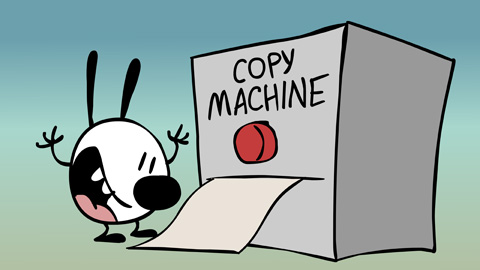
CID1_MimiMakesCopy

The purple-faced man buzzed around me as a cordon of tutting staff formed at the door, edging me closer and closer to a calamitous meltdown. Colleagues peppered me with useful questions. “Do you at least know where the original is?” and “I suppose you realise I’m going to be late for my meeting now?”

Buzz, buzz, buzz!

Someone edged in just a fraction too close and the precariously balanced piles of copying fell to the floor.

Buzz, buzz, buzz.

The machine emitted a deathly metallic scraping noise and then belched a final plume of grey smoke.

“Oh no, look what you’ve done now,” moaned one of the tutters at the door.

It was the final straw. I snapped.

I rose from my hands and knees, dusted down the remains of my self-respect, and with as much calm as I could muster went to fetch a hammer. The drop jaw look on faces as I systematically smashed and pummeled the photocopier into a mangled wreck of twisted polycarbons was somewhere between shock and fear, and the purple-faced man, far from blowing a fuse and sacking me on the spot, proclaimed admiration for my forthright sense of self-expression, gave me the nickname ‘Mad Dog’ and then stood back in awe as I went on to become one of the most ruthless and admired business tycoons of my generation.

I wish. In truth I never made it up off my knees. My colleagues tutted themselves into a frenzy of self-flagellation and the purple-faced man had to go to his meeting armed with just a few well-shuffled sections of his report.

It did however teach me a very important lesson about machines. That once you get past their glossy sheen of usefulness, they are essentially evil. And that one day, if we’re not careful, they’re going to gang up on us and take over the world.

And it would seem, if the findings of an eminent authority on the subject, Louis Del Monte, physicist, entrepreneur, and author of “The Artificial Intelligence Revolution” are anything to go by, that the day of reckoning (or ‘singularity’ as he prefers to call it) might soon be upon us.

“Today there’s no legislation regarding how much intelligence a machine can have, how interconnected it can be,” he recently told Business Insider magazine. “If that continues, look at the exponential trend. We will reach singularity by 2045 and from that point on the top species will no longer be humans, but machines.”

Del Monte doesn’t think the takeover will come in the shape of a ‘Terminator’ style war, so much as a marriage which eventually goes wrong. That humans will willingly allow themselves to be turned into cyborgs [part human, part tech or machine] – a trend we are already seeing with faulty limbs being replaced with artificial parts, and computer controlled pacemakers – and that by the end of this century, most of the human race will have become cyborgs. The allure being immortality.

But eventually of course the machines will view us as an unpredictable and dangerous species. A species that creates wars, has enough weapons to wipe out the world twice over and which makes computer viruses. Hardly an ideal spouse.

Indeed a 2013 experiment at the Laboratory of Intelligent Systems in the Ecole Polytechnique Fédérale of Lausanne, Switzerland designed and built some robots with the specific purpose of cooperating with each other in finding beneficial resources like energy, while avoiding hazardous ones. Shockingly, the robots learned to lie to each other in an attempt to hoard the beneficial resources for themselves.

“The implication is that they’re also learning self-preservation,” Del Monte concludes, “Whether or not they’re conscious is a moot point.”

As worrying as this might sound, if my own conclusions from the photocopier incident are correct, we’ll be perfectly safe, unless the machines start ‘ganging up on us’.

Uh oh, that reminds me. Have you heard of something called the ‘internet of things’? The toasters are apparently talking to the washing machines, the life support units are chatting to the electricity meters, and the traffic lights are colluding with the driverless cars.

All of which equates I think to ‘ganging up’.

Which means there is only one course of action remaining. I must devote the rest of my life to inventing a time machine and then take a leaf from Arnie’s book and travel back in time to that fateful day in the photocopying room. Only this time I must not shirk from my task, but find that hammer and do the job properly, exactly as I once imagined.

That act alone will galvanise the human race to rise up and reject the inevitability of mechanical servitude. Which means of course that this computer I am using now will never exist. So, if you never get to see this article, you can rest easy in the knowledge that I was successful, that my actions inspired a powerful human backlash and that the takeover by machines was averted.

If however, you’re reading it now…

Buzz, buzz, buzz.

© Joe Swain April 6th 2016
joeswain@hotmail.com

More stories like this here hackwriters.com

Are Alzheimer’s Disease and Dementia one and the same? by Ann Bird.

what-is-dementia

Many people use the words “dementia” and “Alzheimer’s disease” interchangeably. However, they are not the same thing. A person can have a form of dementia that is completely unrelated to Alzheimer’s disease.
The term Dementia does not refer to a specific disease, instead it describes a group of symptoms which affect memory, thinking and social abilities severely enough to interfere with daily functioning. It includes memory loss, personality change and impaired intellectual functions resulting from disease or trauma to the brain.
Dementia is progressive and can arise from many different causes which will all involve loss of memory, but they have other symptoms which are different depending on the cause.
There are over 100 different types of dementia, with Alzheimer’s disease, being the most common form. Although it is more common in people over age 65, it is not a normal part of the ageing process as younger people are also affected by it.
While, memory loss generally occurs in dementia, memory loss alone doesn’t mean you have dementia. Unfortunately, there is a certain extent of memory loss that is a normal part of ageing.
The most common causes of dementia include:
• Neurological diseases, Alzheimer’s disease falls under this category.
• Disorders that affect the blood circulation in the brain such as:
A major stroke or severe concussion
• Infections of the Central Nervous System such as:  Meningitis
• Long term alcohol or drug use
• Certain types of hydrocephalus, characterised by a build-up of fluid in the brain.
• There are also some reversible types of dementia such as those caused by drug interactions or vitamin deficiencies.

Alzheimer’s disease is a very specific form of dementia, with symptoms including impaired thought, impaired speech, and confusion.

On the other hand, Alzheimer’s disease is a neurological disease, caused by a dysfunction in one or several areas of the nervous system. During the course of Alzheimer’s disease, proteins build up in the brain to form structures called ‘plaques’ and ‘tangles’, which lead to the loss of connections between nerve cells, and eventually to the death of the cells in the brain. There is also a shortage of important chemicals which help to transmit signals around the brain. When there is a shortage of this chemical, the signals are not transmitted as effectively.

Dementia-vs-Alzheimers-Chart_fullsize
When a person is diagnosed with dementia, they are being diagnosed with a set of symptoms. This is similar to someone having a fever. Their temperature is elevated but the cause is unknown. It could be allergies, sore throat, or the common cold. Similarly, when someone has dementia they are experiencing symptoms without being told what is causing those symptoms.
Another major difference between the two is that Alzheimer’s is not a reversible disease. It is degenerative and incurable at this time, while some forms of dementia, such as a drug interaction or a vitamin deficiency, are actually reversible or temporary.

For more on this topic and to hear how you can help and prepare for Dementia tune in to Ann’s shows with me. 


  LISTEN TO ANN’S SHOW WITH ME HERE

globaldementiacare.com 

facebook.com/ann.bird.

linkedin.in/ann-bird

Ann Bird bannnore@virginmedia.com

Download PDF here   DEMENTIA -The Module1 final portrait

FIND MORE SHOWS OF ILLUMINATION HERE