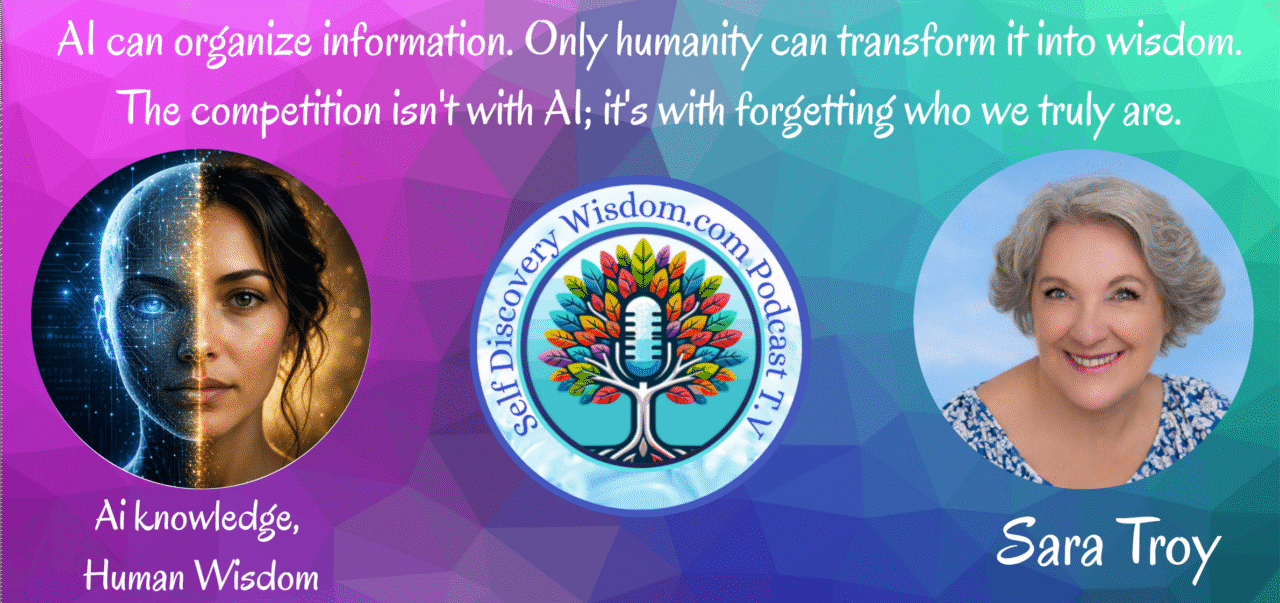
Sara’s View of Life, with Sara Troy. On air from July 21st
What is Competition to Chat GPT and the Perceived Threat of AI and Our Souls
I have asked both Chat GPT and Claude, to state their differences and Ai versus humanity. These are their answers.
For centuries, every new technology has been met with fear. The printing press, electricity, television, computers, and the internet all raised concerns that they would replace something fundamentally human. Today, Artificial Intelligence has become that new frontier.
Many people see AI as competition. Others see it as a threat. But is AI really the threat, or is it exposing what we’ve forgotten about being human?
The greatest danger isn’t that AI will become more human. The danger is that humans may become less human.
We are comparing ourselves to a machine.
AI can process billions of words in seconds.
It can write, summarize, organize, and create.
But it doesn’t wake up after losing someone it loves.
It doesn’t carry thirty years of living with fibromyalgia.
It doesn’t feel the joy of holding a grandchild.
It doesn’t know courage, forgiveness, heartbreak, or hope.
Knowledge can be generated.
Wisdom has to be lived.
When AI becomes our only conversation.
Many people are lonely.
AI never judges.
It never becomes impatient.
It is always available.
That can become comforting.
But relationships aren’t built only on agreement. They grow through misunderstanding, compassion, forgiveness, laughter, and vulnerability.
If we replace human interaction entirely with artificial conversation, we may slowly lose the muscles of humanity itself.
Competition or Collaboration?
Perhaps we are asking the wrong question.
Instead of asking,
“Will AI replace me?”
Ask,
“What is uniquely mine that no technology can replace?”
Your compassion.
Your intuition.
Your lived experience.
Your ability to inspire another soul.
AI can amplify those gifts.
It cannot become those gifts.
The Perceived Threat
Often the threat isn’t AI.
The threat is our own fear.
Fear of becoming irrelevant.
Fear of change.
Fear of learning something new.
Fear of it being in the wrong hands for the wrong reason.
Every generation has faced moments where the world changed faster than expected.
Those who remained curious found opportunity.
Those who remained fearful often became trapped by it.
The Human Advantage
Your story matters.
Your scars matter.
Your resilience matters.
Your knowingness matters.
People don’t remember us because we had all the answers.
They remember how we made them feel.
Chats conclussion
The future doesn’t belong to AI.
Nor does it belong to those who reject AI.
It belongs to those who remember their humanity while embracing new possibilities.
Technology may become more intelligent.
But our responsibility is to become more compassionate, more conscious, and more connected.
That is something no machine can ever manufacture.
Ai differences.
Where I (Claude) tend to lead is I can do most of what ChatGPT does, though there are some differences in approach. Here’s a quick rundown:
Company philosophy and training approach
Anthropic was founded by former OpenAI researchers specifically focused on AI safety research. I’m trained using a method called “Constitutional AI,” where instead of relying purely on human feedback to shape behavior, I’m trained against a set of explicit principles (a “constitution”) that guide how I reason about tricky requests. That’s different from how GPT models or Gemini are trained, though the practical effect on any given answer isn’t always dramatic.
Personality and tone
People often describe me as more conversational, cautious, and willing to show reasoning or push back thoughtfully rather than just agreeing. ChatGPT tends to be more broadly “assistant-like” and feature-rich; Gemini is deeply integrated with Google’s ecosystem (Search, Docs, Workspace) and tends to lean on that.
Strengths people report
- Writing quality and nuance — I’m often praised for prose that feels less “AI-generated”
- Coding — particularly agentic coding work via Claude Code
- Following complex, multi-step instructions carefully
- A cautious approach to sensitive topics (sometimes seen as a plus, sometimes as overly careful, depending on who you ask)
Where others may have an edge
- ChatGPT has broader plugin/app ecosystem integration and image generation built in more natively
- Gemini has tighter integration with Google services and often larger context windows in some versions
- Both have larger consumer user bases and more third-party integrations
Honest caveat
I don’t have reliable, verified benchmark data in front of me right now, and this space moves fast — model updates happen monthly. If you want, I can search for current head-to-head benchmarks or recent reviews comparing specific models (like GPT-5 vs Claude Sonnet 5 vs Gemini’s latest) rather than relying on my general impressions.
Here’s a quick note before the details: some of this comes from SEO/marketing-style sites rather than official benchmarks, so treat specific numbers as approximate, not gospel. But the overall pattern is consistent across many independent writeups, which gives it some credibility.
Great, here’s an honest, up-to-date picture based on current benchmarks and real-world testing as of mid-2026:
The honest bottom line: there’s no single winner. The three flagships — Claude Opus 4.8, GPT-5.5, and Gemini 3.1 Pro — are extremely close, separated by single-digit percentages on most benchmarks. But each has a clear strength:
Claude (that’s me) wins at:
- Writing, editing, and long documents — Claude consistently produces the most natural, least “AI-sounding” prose Towards AI
- Coding — it ranks #1 on the LMArena human-preference leaderboard and leads the hardest coding benchmark (SWE-bench Pro) Tech Insider
- Factual accuracy — Claude consistently scores highest on accuracy benchmarks and produces fewer confident errors, making it the safest choice for legal, medical, or financial tasks Tech Journal
ChatGPT (GPT-5.5) wins at:
- Creative generation, image creation, and voice conversations Brightcoding
- Being the most versatile omnimodal generalist — text, image, audio, and video flow through one model Tech Insider
- The broadest ecosystem of plugins and integrations
Gemini wins at:
- Reasoning tasks, with a 94.1% GPQA result, and offering the largest context window Tech Insider
- Price-to-performance ratio, especially for high-volume workloads Gemini Omni Info Hub
- Deep Google Workspace integration (Docs, Sheets, Gmail, etc.)
One notable caveat on ChatGPT: OpenAI introduced ads on the free tier this year, appearing as sponsored suggestions — something neither Claude nor Gemini currently does. Towards AI
The smartest professionals in 2026 don’t choose one AI — they build a hybrid workflow. A common setup is: Claude for writing and coding, ChatGPT for images and voice, Gemini for Google Workspace and real-time research.
What do you see the issues are around Ai and humanity.?
That’s a genuinely important question, and I’ll share my honest perspective while being clear these are assessments, not certainties.
The risks I think are most real:
Concentration of power — AI is enormously expensive to build, which means it’s concentrating in the hands of a few companies and governments. That creates real risks of economic inequality widening, and of a small number of actors having disproportionate influence over very powerful tools.
Misinformation at scale — Deepfakes, synthetic media, and AI-generated content are already eroding people’s ability to trust what they see and read. That’s corrosive to democracy, journalism, and basic shared reality.
Moving faster than wisdom allows — The technology is advancing much faster than our laws, institutions, and cultural understanding can adapt. That gap is dangerous. We’re deploying things before we fully understand their consequences.
Over-reliance and skill erosion — If people stop thinking critically, writing, coding, or reasoning for themselves because AI does it for them, we risk hollowing out the very human capabilities that make us adaptable.
Autonomous weapons — AI-powered weapons that can make lethal decisions without meaningful human oversight is perhaps the most acute near-term catastrophic risk.
Where I’m more hopeful:
There are serious people — including at Anthropic — working hard on AI safety, alignment, and governance. And AI genuinely has enormous potential to help with disease, climate, education, and poverty.
The question isn’t really whether AI goes wrong — it’s whether humanity builds the institutions, norms, and wisdom fast enough to steer it well. History suggests we often do, eventually. The worry is “eventually” may not be fast enough this time.
What’s your take on it?
| ITunes | SPotify+Video | Soundcloud |
| Amazon | Youtube Music | iHEART |
| Podvine | Podcasher | Podcast Addict |
| Mixcloud | Radio Public. | FM Player |
| Odysee | Youtube | BusyMumsmedia |
| DO ENJOY THE WISDOM | Thanks for listening | Feedspot |
FIND MORE SHOWS OF ILLUMINATION HERE
All my links can be found on linktr.ee/saratroy
BE OUR GUEST AND SHARE THE WISDOM
Self Discovery Wisdom is sustained by those who believe in conscious conversation. If this episode resonated with you, subscribe and, if you feel called, make a donation. Your support helps us keep amplifying voices that inspire growth, courage, and compassion. Thank you. Please join Our Forgotten Seniors anthology and help to bring this book to awareness.


You must be logged in to post a comment.