I was born on October 6th, 1954, just after midnight. My mother had gone into labor on the Wednesday before and had apparently said, “Thank God she’s not going to be a Wednesday’s child, because Wednesday’s child is full of woe.” Well, I waited until just after midnight on Wednesday to be born anyway. Looking back, I can smile at that now, because yes, there has certainly been some woe in my life, but whether we can blame Wednesday for it is another matter altogether.
As I turned ten, life still carried a sense of comfort and familiarity. My father was alive, and we were living in a beautiful home in Louth, England—surrounded by gardens, open space, and a rhythm that felt secure, even though I was away at boarding school for much of the time. Coming home brought a sense of grounding, of knowing where I belonged. But everything changed at eleven. My father suffered another heart attack, and this time, he didn’t recover.
I thought I would take a tiny look back on my seven decades, and revisit the memories.
Age 20 – Stepping Into the World. The Decade 20–30: The Years That Made Me
There are decades in our lives that quietly pass… and then there are decades that shape us.
My twenties were not a gentle unfolding. They were a leap—into the unknown, into the world, and into myself.
At twenty, I didn’t step out with a clear plan or a mapped-out future. I stepped out with curiosity… with openness… and with a heart that believed in humanity.
And that, as I would come to learn, was both my gift… and my lesson.
In my thirties, life wasn’t something I was simply living—it was something I was holding together. On the outside, it looked like I was doing it all: raising my now 3 children, building businesses, clothing shop called Tabytha’s Wear Unusual, creating opportunities, moving between places, traveling back into England and the States. There was movement, there was momentum, there was creation. But beneath it all… there was a constant stretching of self.
I’m your host, Sara Troy, and this is my fifth decade in the series of seven shows reflecting on my seventy-one years of life. Each episode looks at one decade, and this one is my forties into my fifties. If you want the wider life story, with more of the detail and perspective, that lives in my book, Sara’s Self-Discovery to Soul Living. But today, I want to share what this decade truly felt like, because my forties were a very tumultuous time, yet also the beginning of my liberation.
In my mid-fifties into my mid-sixties, everything began to shift. After asking for the divorce at the end of my forties, I stepped into a chapter that was no longer about just surviving—it was about finding my way forward, even when I didn’t yet know what that path would look like.
Self Discovery Wisdom is sustained by those who believe in conscious conversation. If this episode resonated with you, subscribe and, if you feel called, make a donation. Your support helps us keep amplifying voices that inspire growth, courage, and compassion. Thank you. Please support Our Forgotten Seniorsanthology and help to bring this book to awareness.
Raising Our Gifted Childrenwith Sara Troy and her guest Dr. Susan L. Blumberg, Ph,D. On air from April April 14th
I help families go from chaos and conflict to mutual trust, respect and connection, and help teens become the successful, independent adults they are meant to be. I help all teens, but love working with neurodivergent and twice exceptional teens.
I also specialize in working with youth and adults with Nonverbal Learning Disability and Autism Spectrum Disorder.
I am passionate about helping people reach their goals. For over thirty years, my goal has been to help children, adolescents, adults, and families to overcome stress, anxiety, depression and other obstacles to find joy and success in their own lives. Why? Because working with families and individuals to achieve their life goals is my goal in life! I find great satisfaction in supporting my clients through their tough times, in helping them think through issues, and in resolving emotional and behavioral problems.
I’m a married mother of two young adult, twice-exceptional children. I’ve lived in Colorado for over 40 years, but I still think of myself as a New Yorker!
My background in cognitive behavioral therapy informs my work as a life coach, as I help people set goals, plan their journey, and achieve success. I worked as a licensed clinical psychologist for over 20 years, in mental health agencies, in private practice, and for the federal government overseeing child welfare and adoption services in the Rocky Mountain region. This has given me a solid and varied background, and extensive level of experience.
Working as a special education advocate for 40 years means I have honed my skills as a negotiator, my ability to collaborate, and my understanding of being a team member. I always put your child first. I have training from the Arc, Wrightslaw, and I was a member of COPAA, the Council Of Parent Attorneys and Advocates. I have sat on both sides of the IEP table, as a professional and a parent, which gives me an unique perspective. Though I am not currrently taking new clients, I am available for consultation as needed.
I am also the coauthor of multiple books, including Fighting for Your Marriage (2010, Markman, Stanley & Blumberg), 12 Hours to a Great Marriage (2003, Markman, Stanley & Blumberg) and Parenting a Child with Sensory Processing Disorder: a family guide to understanding and supporting your sensory-sensitive child (2006, Auer & Blumberg).
University of Denver, MA, 1983; PhD, 1991 Brandeis University, BA, 1980.
Self Discovery Wisdom is sustained by those who believe in conscious conversation. If this episode resonated with you, subscribe and, if you feel called, make a donation. Your support helps us keep amplifying voices that inspire growth, courage, and compassion. Thank you.
Sara’s View of Life with Sara Troy. On air from March 31st
I’m your host, Sara Troy, and this is my second decade. After a recent conversation about turning 71, it was pointed out to me that this represents seven full decades of life—and when you begin to look at life in those ten-year chapters, it shifts your perspective entirely. Although I wrote Sara’s Self-Discovery to Soul Living as a reflection of my journey, I felt called to break my life down into those decades. Last week, I shared my first ten years; this week, we step into the years from 10 to 20—a time filled with profound change, loss, awakening, and the shaping of who I would become.
As I turned ten, life still carried a sense of comfort and familiarity. My father was alive, and we were living in a beautiful home in Louth, England—surrounded by gardens, open space, and a rhythm that felt secure, even though I was away at boarding school for much of the time. Coming home brought a sense of grounding, of knowing where I belonged. But everything changed at eleven. My father suffered another heart attack, and this time, he didn’t recover.
I remember that moment with a clarity that never leaves you. There was love, of course, but also an unexpected feeling of relief—relief that his suffering, his frustration, and the anger that had come with his illness were finally at peace. And with that came guilt, because as a child, you don’t yet understand that two emotions can coexist. I forced myself to grieve in the way I thought I should, yet something deeper in me already understood that death was not an end, but a transition.
In the days that followed, I found myself stepping into a kind of knowingness I couldn’t explain. When I said goodbye to my father, it was simple, heartfelt, and complete. And when I spoke to my mother, words came through me—words far beyond my years—offering a perspective of strength in the face of loss. It was as if, even then, something within me knew how to meet life in its hardest moments.
But life did not soften after that. The reality of loss unfolded quickly—family tensions, financial instability, and the harsh truths of how vulnerable we could be. At school, I faced illness, isolation, and cruelty from others who didn’t understand or believe what I had gone through. Yet even in those moments, something in me endured. I didn’t yet call it resilience, but it was there—quietly forming.
That decade, from ten to twenty, became a shaping ground. It was where innocence met reality, where hardship introduced awareness, and where the seeds of who I would become were planted. It wasn’t an easy time, but it was a defining one—one that taught me, even then, that strength is not loud, and knowing often comes long before understanding.
Then came another turning point. At fourteen, my mother made a bold and life-changing decision—we would leave England and begin again in South Africa. The journey itself was an adventure, a three-week voyage by sea, arriving in a world so different from anything I had known. The light, the heat, the sounds, the energy—it was as though life had shifted into an entirely new landscape.
In South Africa, I began to change. The shy, timid girl who struggled to find her place slowly started to open. I found myself stepping into experiences I never would have imagined—dancing, music, connection, even becoming a go-go dancer and part of the emerging DJ scene. There was a freedom there, an aliveness, a sense of expression that had been waiting within me. Life was no longer just something happening to me—I was beginning to participate in it.
That decade, from ten to twenty, became a powerful shaping ground. It was where innocence met reality, where loss met discovery, and where hardship gave way to expression and growth. It was not an easy road, but it was a transformative one. It taught me that even in the face of change, disruption, and uncertainty, there is always something within us ready to rise, to explore, and to become.
In South Africa, I began to change. The shy, timid girl who once held back started to find her rhythm in the world. It was there that I stepped into something completely unexpected—the world of music, movement, and expression. Through connections and opportunity, I found myself part of a growing disco scene, where energy, sound, and freedom came together in a way that felt alive and liberating.
I became a go-go dancer, and for the first time, I wasn’t hiding—I was expressing. There was joy in it, a sense of belonging in the music, in the beat, in the shared experience of people coming together simply to feel good. Alongside that, I was involved in the DJ world, helping bring music to life at parties, events, and gatherings. In those days, it wasn’t polished or commercial—it was raw, creative, and full of spirit. We carried heavy equipment, set everything up ourselves, and created the atmosphere from the ground up. It was hard work, but it was also exhilarating.
That experience gave me something I hadn’t known before—confidence. It allowed me to step out of my shell, to connect with people, to read energy, and to understand how to move a room, not just physically, but emotionally. Music became a language, and dance became a form of communication. It was no longer about fitting in—it was about showing up as I was, fully present in the moment.
Those years were vibrant, full of discovery, and deeply formative. From loss and uncertainty, I had stepped into expression and aliveness. The girl who once felt small and unsure was beginning to find her voice—through music, through movement, and through the courage to simply be seen.
Yet, even within that sense of freedom and expression, there was another reality unfolding around me—one that was far from free. Living in South Africa during the time of Apartheid meant that, beneath the music and movement, there was a deeply divided and unjust society. It was something you could feel, even when people didn’t openly speak about it. There were invisible lines everywhere—who could go where, who could do what, who was seen and who was not.
At the same time, there was also the weight of Misogyny—something I had already begun to experience earlier in life, but now saw more clearly. Women were often expected to stay within certain roles, to be seen but not truly heard, to follow rather than lead. I had watched my own mother’s independence be taken from her, her business sold without her consent, her voice diminished in a world that prioritized men’s authority.
So here I was—dancing, expressing, finding my voice in one space—while simultaneously becoming aware of how restricted that voice could be in the larger world. It was a stark contrast. On the dance floor, there was freedom, connection, and joy. Outside of it, there were systems built on control, division, and inequality.
And perhaps that contrast became one of my greatest teachers. It showed me the difference between what is and what could be. It awakened in me an awareness of injustice, not just for myself, but for others. It planted seeds—of compassion, of questioning, of a desire for something better, something fairer, something more humane.
Those experiences didn’t harden me—they opened me. They helped shape my understanding of humanity, of the importance of voice, of equality, and of standing in one’s truth. Even then, I was beginning to see that life is not just about surviving what we are given, but about becoming aware enough to help change what no longer serves humanity.
And through all of this, there was my mother—at the center of it, navigating her own journey of loss, identity, and rediscovery. After my father’s passing, she had been a woman stripped of so much—her security, her independence, even her voice in many ways. I had watched how her business was taken from her, how decisions were made around her rather than with her, and how society expected her to quietly accept it all.
But South Africa awakened something in her.
I began to see a different woman emerge—not just the grieving widow, but a woman reclaiming herself. She stepped into new spaces, met new people, and began to rediscover her independence and creativity. There was a light returning to her, a sense of possibility that had been dimmed for so long. She had always had strength, but now it was beginning to express itself in a new way—less confined, more exploratory.
She showed me, not through words but through living, what it means to rebuild. To take what life has stripped away and, piece by piece, begin again. It wasn’t easy, and it wasn’t without pain, but there was a quiet determination in her—a resilience that spoke volumes.
Watching her, I learned something profound. That no matter how much is taken from you, there is always something within that cannot be taken—your spirit, your will, your capacity to rise again. She didn’t fight loudly against the world that had wronged her; instead, she chose to step forward into a new life, carrying both her scars and her strength.
And in many ways, as I was finding my voice through music and movement, she was finding hers through rediscovery and reinvention. Together, without even realizing it, we were both stepping into a new chapter—one shaped not just by what we had lost, but by what we were becoming.
Self Discovery Wisdom is sustained by those who believe in conscious conversation. If this episode resonated with you, subscribe and, if you feel called, make a donation. Your support helps us keep amplifying voices that inspire growth, courage, and compassion. Thank you. Please support Our Forgotten Seniorsanthology and help to bring this book to awareness.
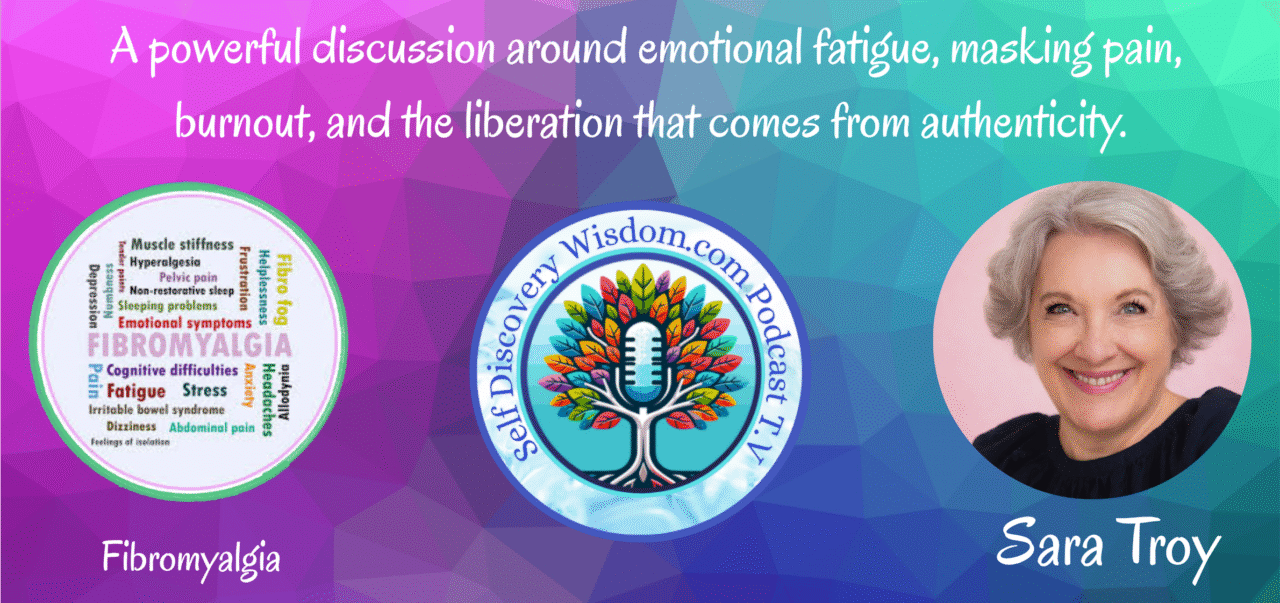
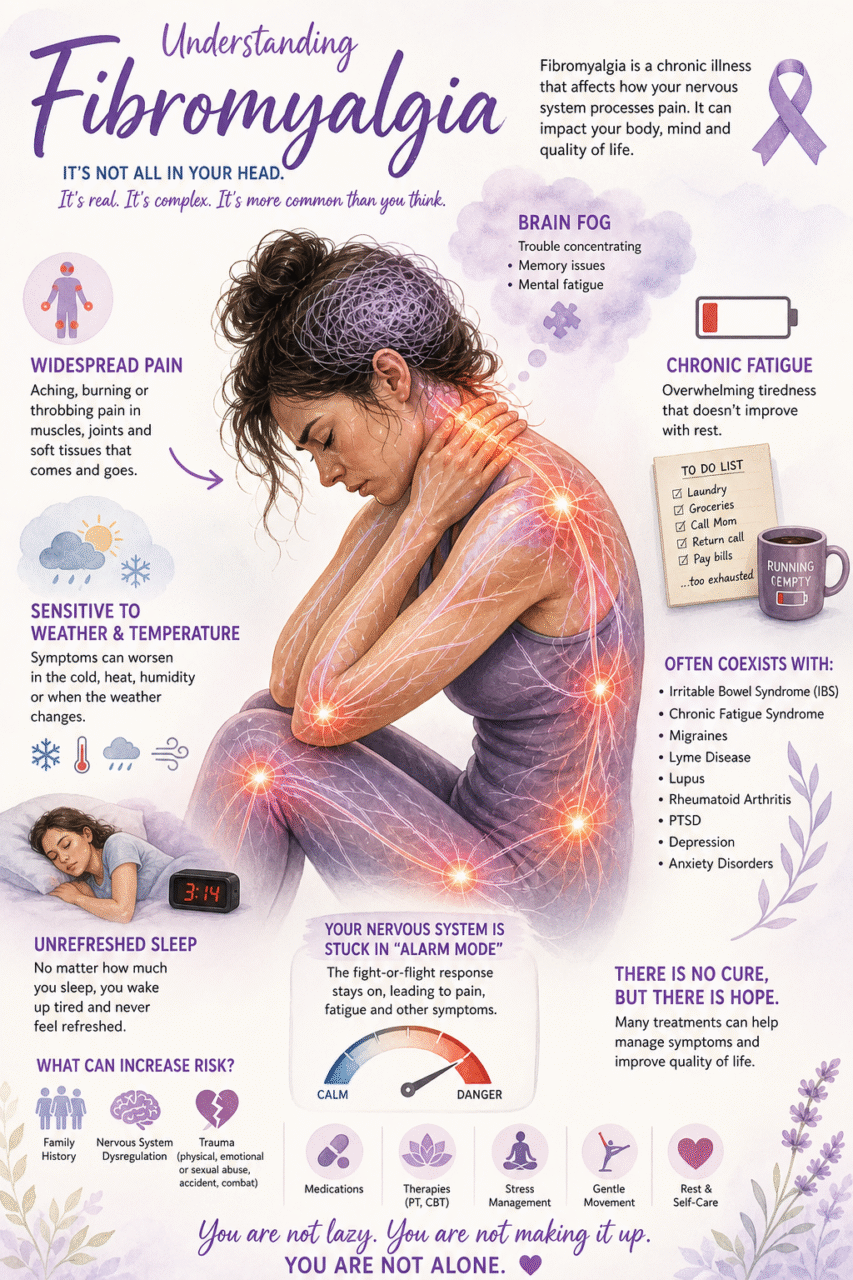
Both ADHD and Fibromyalgia involve a heightened sensitivity in the nervous system.
ADHD: the brain processes stimuli differently—often too much, too fast
Fibromyalgia: the body amplifies pain signals (called central sensitization)
In both, the system isn’t broken—it’s over-responsive.
2. Neurotransmitter Imbalances
Both conditions are linked to irregular levels of key brain chemicals:
Dopamine ? motivation, focus, reward
Serotonin ? mood, pain regulation
Norepinephrine ? alertness, stress response
This overlap explains why people may experience both focus challenges and chronic pain or fatigue.
3. Brain Fog & Cognitive Strain
Many describe:
Forgetfulness
Difficulty concentrating
Mental fatigue
In ADHD it’s often called distractibility; in fibromyalgia, it’s commonly known as “fibro fog.” But the lived experience can feel very similar—like trying to think through mist.
4. Sleep Disturbances
Sleep is often disrupted in both:
ADHD: difficulty settling the mind
Fibromyalgia: non-restorative sleep (you sleep, but don’t feel rested)
This creates a loop ? poor sleep ? worse symptoms ? more poor sleep
5. Emotional Regulation & Stress Sensitivity
Both conditions can heighten emotional responses:
ADHD ? emotional impulsivity, overwhelm
Fibromyalgia ? stress can trigger pain flares
The body and mind are deeply connected here—stress is not just emotional, it becomes physical.
6. Co-occurrence (They Often Show Up Together)
There’s growing awareness that people with ADHD are more likely to also experience fibromyalgia (and vice versa).
Why? Likely due to shared underlying patterns:
Nervous system dysregulation
Trauma or chronic stress history
Genetic predispositions
A Gentle Way to See It
Rather than viewing either condition as a “fault,” many now see them as different ways of processing the world—with heightened awareness, sensitivity, and responsiveness.
That sensitivity can be exhausting… but it can also carry deep intuition, empathy, and perception when supported well.
Support Approaches That Often Help Both
Nervous system regulation (breathing, gentle movement, meditation)
ECO Solution with Sara Troy and her guest Peshang Hama Karim, on air from March 31st.
From 2018-2026 what have changed?
There comes a point where we realize peace isn’t something we find—it’s something we choose. Without it, we live in reaction, division, and exhaustion. With it, we begin to respond with awareness, patience, and intention.
Harmony grows from that peace. It doesn’t mean we all agree, but that we learn to live alongside one another with understanding. Respect becomes the bridge—seeing each other’s value, listening without judgment, and allowing space for different journeys.
And from this way of living, responsibility awakens. We begin to see that this Earth is not just where we live—it is our shared home. When we care for one another, we naturally begin to care for the planet.
Peace within… harmony with others… respect for life… leads us to protect what sustains us all.
Peshang Hama Karim, holding Ph.D. in Environmental Sciences majoring in hydrology at the university of Warsaw. Currently he is working as Events Manager with the Climate High-Level Champions. He previously worked, at the World Meteorological Organization and UNESCO’s Intergovernmental Hydrological Programme. A prolific writer, he has contributed significantly to the scientific discourse on climate issues with many publications and has been a speaker from COP27-COP30 conferences. Co-founding the Jingedosty Environmental Organization from his country which reflects his commitment to local environmental action. His dedication extends to organizing events like UN Conferences from COP26-COP30 in Brazil. He organized Regional Conference of Youth in the Asia and Pacific region back in 2022. He was also one of the organizers of Regional Conference of Youth in the Eastern Europe (Warsaw) back in 2023, and UN Water Conference at the UN headquarter in New York, showcasing his commitment to shaping a sustainable future for the next generations.
Self Discovery Wisdom is sustained by those who believe in conscious conversation. If this episode resonated with you, subscribe and, if you feel called, make a donation. Your support helps us keep amplifying voices that inspire growth, courage, and compassion. Thank you. Please support Our Forgotten Seniorsanthology and help to bring this book to awareness.
You must be logged in to post a comment.